Antique Rug Pet Stain Removal: What to Do Before You Clean


For antique rug pet stain removal, start by absorbing fresh moisture with a clean white cloth without rubbing. Do not apply an unverified spot cleaner, shampoo, steam treatment, or household mixture. Photograph the area, note what happened, and contact a qualified rug conservator or specialist when the rug’s fibers, dyes, construction, condition, or value are uncertain.
An antique rug is not simply an older version of modern carpet. Its dyes may be unstable, its foundation may already be weak, and earlier repairs may react unpredictably to moisture. The safest goal at home is therefore limited: contain a fresh accident, avoid adding a second problem, and preserve useful information for the person who assesses the rug.
Key takeaways
- Blot fresh liquid with a clean white absorbent cloth; do not rub, scrub, brush, or press a machine into the pile.
- Pause before adding water or cleaner when the rug’s construction, dyes, repair history, or care instructions are unknown.
- Treat dye transfer, weakened areas, fringe damage, widespread wetting, and old odors as reasons to seek specialist advice.
- Record the accident and every product already used so a conservator can make a better-informed assessment.
Why does an antique rug need a different stain-removal plan?
Antique rug pet stain removal requires a condition-first plan because the same treatment can behave differently on two rugs. The Institute of Conservation explains that stain removal depends on both the substance and the carpet’s composition, while the suitability of wet-cleaning depends on condition, construction, and whether dyes may run.
Modern machine-made carpet instructions may assume stable materials and a known backing. An antique or hand-made rug may combine different fibers in its pile, foundation, fringe, or repairs. Age, light exposure, wear, and previous treatment can also change how those parts respond. That uncertainty is why a successful method used on another rug is not proof that it is suitable for yours.
The practical distinction is simple. On ordinary carpet, a homeowner may follow the current manufacturer’s care instructions. On an antique rug without reliable care documentation, the first decision is whether any further wet treatment is justified. The Institute of Conservation describes wet-cleaning as irreversible and recommends that suitability be determined by a conservator.
What should you do in the first few minutes?
The immediate task is to remove free liquid without spreading it or disturbing the pile. The Canadian Conservation Institute advises soaking up as much liquid as possible with absorbent material, dabbing gently, and avoiding rubbing. The Institute of Conservation likewise recommends absorbent white cloth or blotting paper and says not to rub the affected area.
- Move the pet away calmly. Prevent another step through the area without dragging furniture across the rug.
- Remove loose solids carefully. Lift rather than grind material into the pile. Avoid sharp tools near weakened fibers.
- Place a clean white cloth on the wet area. Apply light, even pressure and lift. Replace the cloth as it takes up moisture.
- Work at the edge of the affected area. Do not scrub inward or outward. The purpose is absorption, not a complete treatment.
- Stop if color transfers. Dye on the white cloth, a change in surface texture, or movement in a fragile section warrants specialist advice.
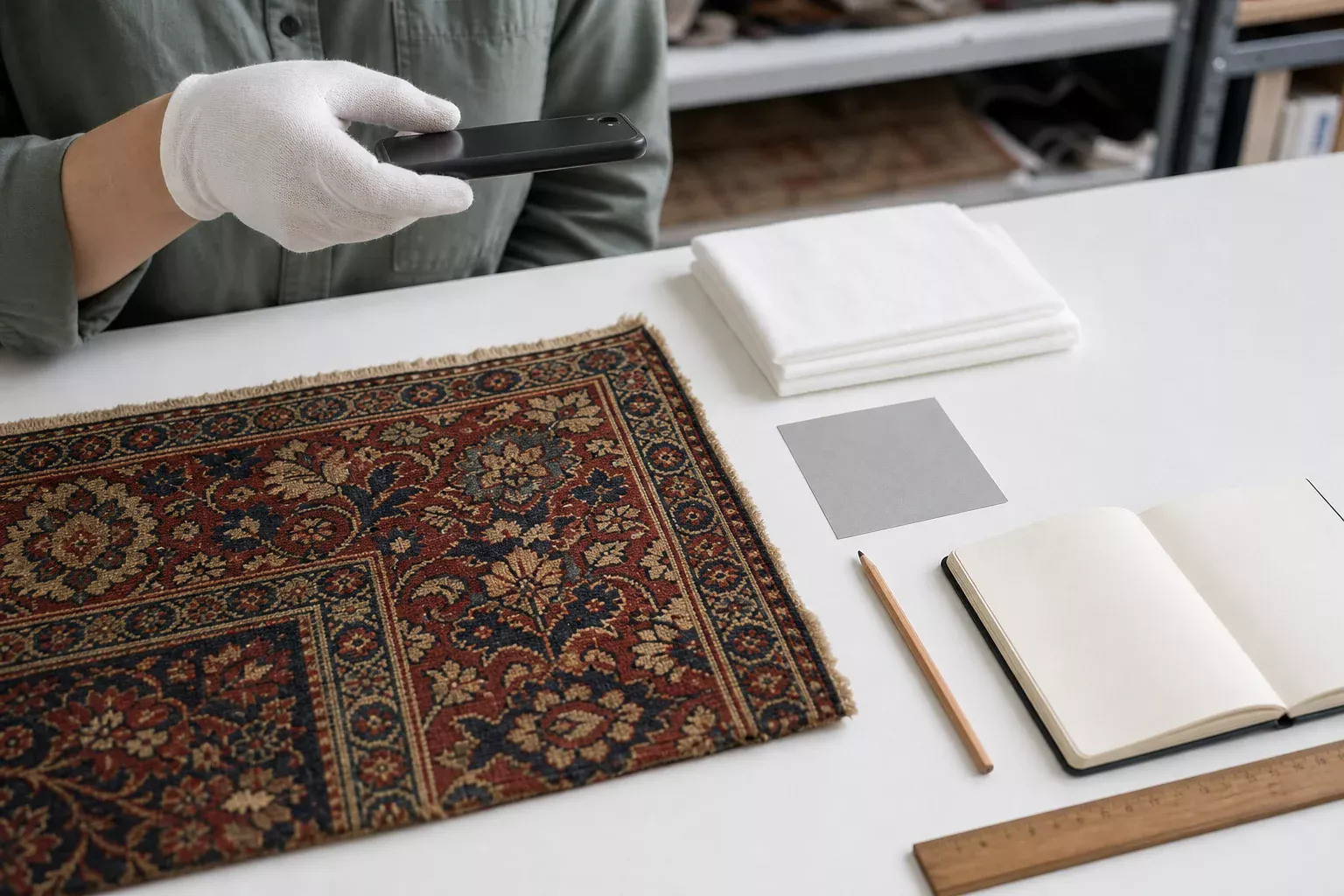
- Record the condition. Photograph the whole rug, the affected area, the reverse if it is accessible without moving the rug, and any label or previous repair.
Important: this is first aid for the object, not a promise that the stain or odor will disappear. Do not keep adding moisture simply because the visible mark remains.
When should you stop DIY treatment?
Stop home treatment when the rug’s response is uncertain or the consequences of a mistake are significant. The Institute of Conservation recommends contacting a conservator for stains and fragile condition; ARCS says not to continue with a test solution when dye transfers or color changes. These limits favor assessment over repeated spot treatment.
| What you observe | Why it matters | Prudent next step |
|---|---|---|
| Color appears on the white cloth | The dye may be moving under moisture or pressure. | Stop and document the transfer; contact a conservator or qualified rug specialist. |
| Loose pile, tears, brittle areas, or weak fringe | Handling and repeated blotting may enlarge existing damage. | Keep people and pets away and seek condition-specific advice. |
| Large wet area or liquid reached the reverse | The foundation and more than one material may be involved. | Do not roll or fold a wet rug; ask a specialist how it should be supported and moved. |
| Old stain or recurring odor | The affected area and previous treatments are not fully known. | Avoid layering another product over unknown residue; arrange an assessment. |
| Mold-like growth or musty change after dampness | Moisture-related deterioration needs controlled handling. | Limit access and contact a conservator promptly. |
The Association of Rug Care Specialists warns that one-size-fits-all spotters can be inappropriate for many rugs. Its guidance also says to stop using a test solution if dye comes off or the rug changes color. For an antique piece, that warning supports a conservative threshold: uncertainty is a reason to pause, not a reason to try a stronger product.
How should you document a pet stain before calling a specialist?
Useful documentation identifies the rug, the accident, the visible change, and every action already taken. Clear photographs and a short timeline reduce guesswork. They do not replace an in-person inspection, but they help a conservator decide what questions to ask and whether the rug needs prompt attention.
- Photograph the full front of the rug in even light.
- Take one wider image showing the stain’s position and one close image showing the pile.
- Include the reverse only if it can be viewed without folding, pulling, or stressing the rug.
- Record when the accident was noticed and whether it was still wet.
- List any cloth, water, cleaner, powder, machine, or odor treatment that touched the area.
- Note dye transfer, texture change, loose fibers, fringe damage, odor, and the approximate affected size.
- Save labels or purchase records that describe construction, provenance, or earlier restoration.
Avoid diagnosing the fiber or dye from appearance alone. A red field is not evidence of one dye type, and a soft pile is not proof of one fiber. Write down what you can observe and label everything else as unknown.
How do you choose an antique rug conservator or cleaning specialist?
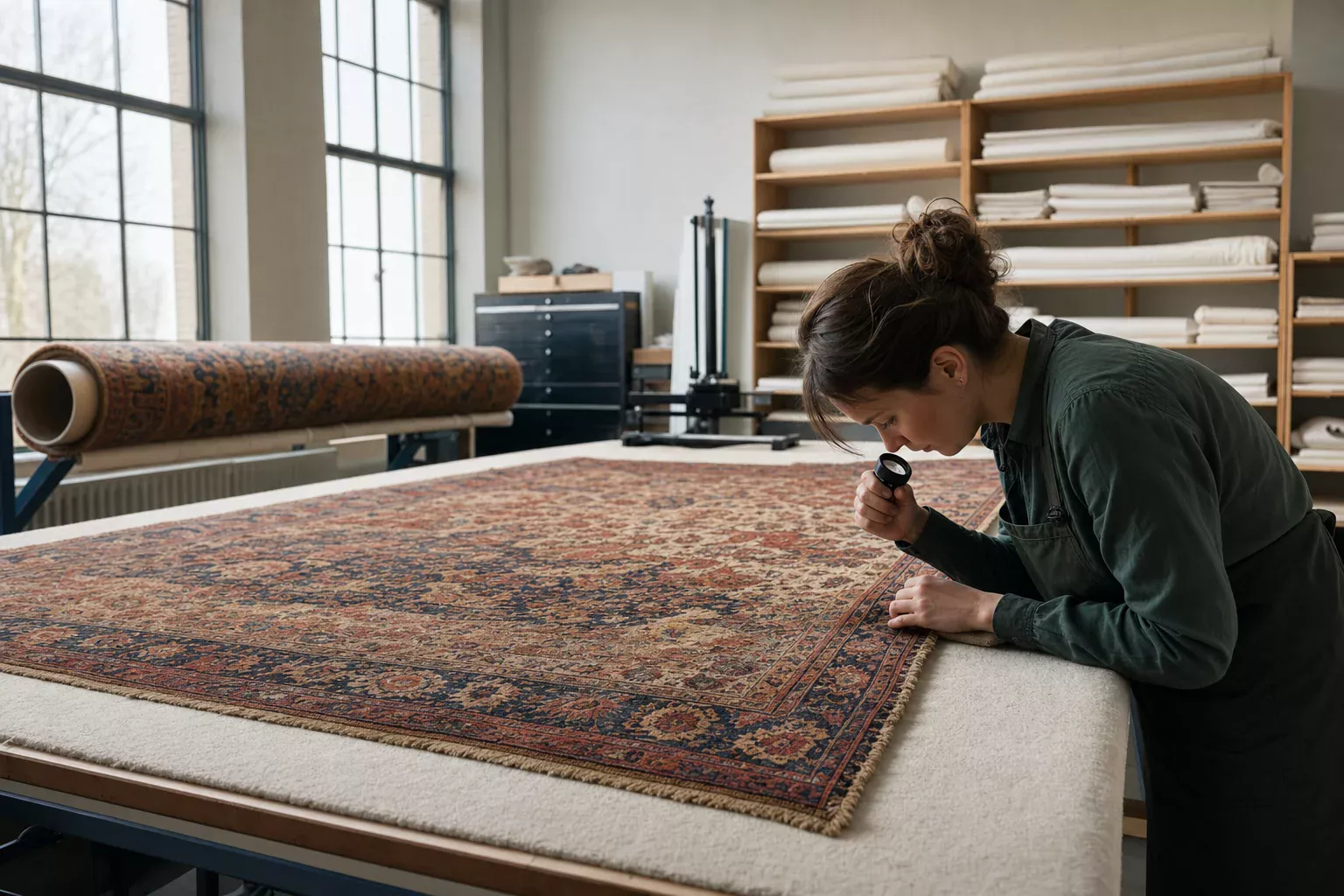
Choose a professional who can explain how the rug will be examined before treatment. BADA recommends professional help for thorough antique-rug cleaning or restoration, while the Institute of Conservation says each rug requires an individual condition assessment. Ask how the specialist will evaluate dyes, structure, repairs, handling, and treatment limits.
Useful questions include:
- Will you inspect the foundation, pile, fringe, repairs, and dye stability before recommending treatment?
- Have you handled rugs of a similar construction and condition?
- Will the work be documented before and after treatment?
- What risks have you identified, and what result cannot be guaranteed?
- How will the rug be supported during collection, transport, treatment, and drying?
- Do you carry appropriate insurance, and will I receive written terms?
Be cautious when the recommendation begins with a standard package before anyone has examined the rug. The British Antique Dealers’ Association advises using a professional firm or dealer for thorough cleaning or restoration, and the Institute of Conservation notes that each rug has individual characteristics requiring its own assessment.
What should you avoid while waiting for professional advice?
While waiting, keep the area undisturbed and protected from traffic. The Institute of Conservation says steam cleaning and carpet shampoos intended for modern machine-made carpets are not appropriate for hand-made rugs. Do not scrub, bleach, deodorize, heat, fold, tape, or move a weakened rug without condition-specific handling advice.
Do not assume that a product labeled for carpet is suitable for an antique rug. Do not combine products or apply a fragrance to mask odor. Added residue can complicate later assessment, and extra moisture can carry the original contamination farther through the pile or foundation.
If the rug is dry and stable, block access with furniture placed around the area rather than on the rug. If it remains damp, ask the specialist for handling instructions. The Institute of Conservation recommends rolling rather than folding rugs for storage, but a wet or damaged rug needs case-specific advice before it is moved.
For standard, non-antique carpet, our guide to removing pet stains from carpet covers a different decision path. A fresh urine accident on ordinary carpet is addressed separately in the pet urine stain guide. Do not transfer either routine to a valuable hand-made rug without confirming suitability.
Frequently asked questions
Can I use an enzyme cleaner on an antique rug?
Do not assume an enzyme cleaner is compatible with an antique rug. The rug may contain unknown dyes, fibers, backing materials, or repairs. Ask a qualified conservator or rug specialist to assess the rug and the exact product before application. A general carpet label does not establish antique-rug compatibility.
Should I use vinegar or baking soda on an old pet stain?
Not without condition-specific professional advice. A household recipe cannot account for the rug’s construction, dye stability, previous treatments, or existing damage. Adding powder or liquid may leave residue, move color, or obscure what was originally present.
Can I steam-clean an antique rug?
The Institute of Conservation says cleaning methods for modern machine-made carpets, including steam cleaning and carpet shampoos, are not appropriate for hand-made rugs. Wet-cleaning is irreversible, so a conservator should determine whether a particular rug is a suitable candidate.
What if the stain has already dried?
Document the area and avoid repeated home treatments. An old stain may include unknown residue and may have reached the foundation. Tell the specialist when it was discovered, what may have caused it, whether odor remains, and what products were previously used.
Does professional treatment guarantee complete removal?
No responsible assessment can guarantee a specific result before the rug is examined. Age, construction, dye behavior, wear, prior repairs, and earlier cleaning all affect what treatment is reasonable. Ask the specialist to explain likely limits and risks in writing.
A cautious next step
Antique rug pet stain removal begins with restraint. Absorb fresh liquid without rubbing, stop when color or structure changes, and preserve a record of the accident. Then let the rug’s actual condition determine what happens next. Browse more surface-specific guidance in the PawPureHome cleaning guides, but keep antique textiles on their own conservative path.
Sources
- British Antique Dealers’ Association, Antique Carpets and Rugs, retrieved 2026-08-03.
- Institute of Conservation, Carpets and Rugs, retrieved 2026-08-03.
- Canadian Conservation Institute, Basic Care: Carpets and Rugs, retrieved 2026-08-03.
- Association of Rug Care Specialists, Spotting Guide for Rug Owners, retrieved 2026-08-03.